


Head Researcher
Diabetes affects hundreds of millions of people worldwide, and among men, one of its most distressing complications is erectile dysfunction (ED). Men with diabetes are significantly more likely to experience ED than those without the condition—and often at a younger age. Because erections rely on healthy blood flow, intact nerve signaling, and proper nitric oxide (NO) function, diabetes directly interferes with the mechanisms required for normal sexual performance.
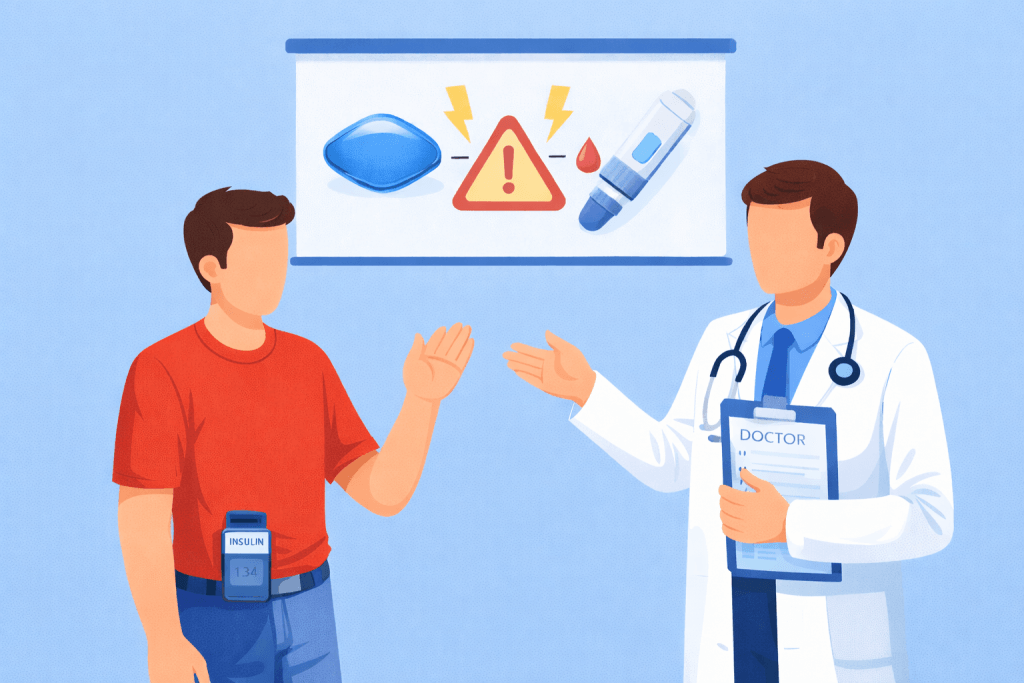
But can diabetics take Viagra? Is the medication effective if nerve damage or vascular disease is involved? This guide examines the mechanism of action behind Viagra, the clinical evidence supporting its use in diabetic populations, safety considerations across different types of diabetes, and whether sildenafil may influence metabolic pathways. Let’s dive in.
Table of Contents
What Is Viagra?
Viagra, by Pfizer, is the brand-name tablet containing sildenafil citrate as its active ingredient. It’s a prescription medication originally developed for cardiovascular conditions and later approved for erectile dysfunction [1]. Sildenafil belongs to a class of drugs known as phosphodiesterase type 5 (PDE5) inhibitors. Its primary action is blocking the enzyme PDE5, which normally breaks down cyclic guanosine monophosphate (cGMP). By inhibiting PDE5, sildenafil enhances the nitric oxide–cGMP pathway, promoting relaxation of smooth muscle in the corpus cavernosum and increasing penile blood flow during sexual stimulation.
Penile erection is fundamentally a vascular event. Nitric oxide released from nerve endings and endothelial cells stimulates cGMP production, which relaxes arterial smooth muscle and allows blood to fill erectile tissue. In men with diabetes, this pathway is often impaired due to endothelial dysfunction, oxidative stress, and accumulation of advanced glycation end products (AGEs), which reduce nitric oxide bioavailability.
Sildenafil is rapidly absorbed, typically reaching peak plasma concentrations within 30–60 minutes, and has a half-life of approximately four to six hours. It is metabolized primarily by hepatic CYP3A4. High-fat meals may delay absorption, but do not eliminate effectiveness.
Importantly, it does not initiate erections independently; sexual stimulation is required for nitric oxide release.
Beyond ED, sildenafil is also approved under different branding for pulmonary arterial hypertension [2]. Enhanced NO bioavailability may improve the endothelial function systemically, not just in the penile vasculature. These vascular effects are particularly relevant in diabetes, where endothelial dysfunction is central to disease progression.
Does Viagra Work for Diabetics?
Yes. Viagra works very well for diabetics. ED and diabetes frequently occur together, and the overlap is far from coincidental. An estimated 52.5% of men with diabetes experience some degree of ED [3]. Men with treated diabetes had nearly a threefold higher rate of complete ED compared to the general population. Importantly, ED in diabetic men tends to appear 10–15 years earlier than in non-diabetic peers.

The underlying cause is typically multifactorial. Chronic hyperglycemia damages endothelial cells, reduces NO synthesis, accelerates atherosclerosis, and impairs autonomic nerve signaling. Diabetes also increases the likelihood of conditions strongly associated with ED, including hypertension, heart disease, obesity, and depression. In addition, diabetic neuropathy can damage the nerves within the corpus cavernosum of the penis. When nerve signaling is impaired, PDE5 inhibitors such as Viagra may be less effective because NO release is already compromised. This can make it bad for certain patients with more severe diabetic complications, where Viagra may not work as well as in others.
Besides, there’s improved insulin sensitivity in overweight individuals with prediabetes after 12 weeks of sildenafil therapy [4]. Also, in a study involving 268 men with diabetes (mean age 57), 56% of participants receiving sildenafil experienced improved erections. Successful intercourse attempts occurred in 61% of the sildenafil group versus 22% in the placebo group. This outcome demonstrates statistically and clinically meaningful improvement [5].
A separate 12-week trial focusing exclusively on men with type 1 diabetes (n=188) showed similarly robust results. Approximately 66% of sildenafil-treated men reported improved erections compared with 29% in the placebo arm. Successful intercourse attempts nearly doubled (63% versus 33%) [6]. Notably, efficacy was observed regardless of baseline glycemic control, smoking status, or history of pre-existing cardiovascular disease.
Also, in a study, sildenafil significantly improves International Index of Erectile Function (IIEF-5) scores and sexual success rates, enhancing erection hardness, sexual performance, and satisfaction for both patients and partners [7]. This reduced efficacy likely reflects the complex pathophysiology of diabetes, which combines arterial insufficiency, neuropathy, endothelial dysfunction, and sometimes hypogonadism.
In a study of 466 men with ED (382 diabetic, 84 non-diabetic), sildenafil significantly improved erectile function and overall satisfaction. Efficacy was lower in patients with poor glycemic control, longer diabetes duration, or multiple complications, but overall patient satisfaction remained high. Sildenafil was effective across varying ED severities, restoring functional erections in most participants [8].
ED in diabetic men may serve as an early marker of systemic vascular disease. Penile arteries are smaller than coronary arteries, so endothelial dysfunction may manifest as erectile problems several years before overt cardiovascular events. For this reason, ED in diabetes should prompt not only sexual health treatment but also broader cardiovascular risk assessment.
In summary, while diabetes can make ED more complex and sometimes harder to treat, substantial clinical evidence demonstrates that sildenafil remains effective for the majority of diabetic men. Even in long-standing disease, meaningful improvements in erection quality and sexual performance are common when treatment is appropriately prescribed and underlying risk factors are addressed.
Is Viagra Safe for Any Type of Diabetes?
Yes. Safety is understandably a primary concern because diabetes frequently coexists with cardiovascular disease, hypertension, neuropathy, nephropathy, and other microvascular complications. Fortunately, Viagra is generally safe and well-tolerated in any man with stable type 1 and type 2 diabetes when prescribed appropriately.
In a study, sildenafil significantly improved erectile function in men with diabetes. 56–57% of patients reported improved erections versus 10% with placebo, and successful intercourse attempts were 4-fold higher with sildenafil. Efficacy was consistent across age, ED duration, and diabetes type. Treatment was well-tolerated, with mild, transient side effects and no serious safety concerns [9].
The most common side effects are headache, flushing, dyspepsia, nasal congestion, dizziness, and mild visual disturbances such as blue-tinted vision [10]. These effects are dose-dependent, usually mild to moderate, and typically resolve without intervention. There’s no significant increase in myocardial infarction or cardiovascular mortality when sildenafil is used according to prescribing guidelines [11].
Cardiovascular safety is crucial because sexual activity increases cardiac workload. Evidence indicates that in men with stable coronary artery disease who are not on nitrates, sildenafil does not significantly alter exercise tolerance or induce ischemia. However, the major contraindication remains concurrent nitrate therapy (e.g., nitroglycerin or isosorbide), as this can cause profound hypotension.
Importantly, sildenafil does not interfere with insulin or common oral diabetes medications like metformin, sulfonylureas, SGLT2 inhibitors, or GLP-1 receptor agonists. Additionally, in prediabetic patients, sildenafil improved insulin sensitivity, potentially enhancing glucose uptake and endothelial function [12]. Further, daily sildenafil restored gastric emptying in diabetic mice with gastroparesis [13].
With proper screening, individualized dosing, and physician oversight, sildenafil remains a first-line therapy for erectile dysfunction in diabetic populations, supported by clinical evidence.
Conclusion
Men living with diabetes face an increased risk of impotence due to vascular damage, endothelial dysfunction, neuropathy, and sometimes hormonal imbalance. These issues impair blood flow and nerve signaling, making it harder to achieve and maintain an erection. Despite these challenges, sildenafil remains the best first-line treatment for ED in both type 1 and type 2 diabetes. It can help many men by improving blood flow, but its effectiveness may vary depending on individual health factors. For those with cardiovascular issues or other medications, it might be OK, though a careful consultation with a doctor is crucial to avoid potential interactions.
For men with stable diabetes who aren’t on nitrate medications and have had an appropriate cardiovascular evaluation, sildenafil is generally safe and well-tolerated. Side effects are typically mild and temporary, and there’s no indication that it affects blood sugar control negatively. The good effects can extend beyond sexual health, improving overall vascular function. Comprehensive management, including glucose control, lifestyle changes, and screenings, ensures significant improvements in erectile quality and quality of life.
References:
- Viagra’s famously surprising origin story is actually a pretty common way to find new drugs. By Katherine Ellen Foley. Retrieved: March 2, 2026. Qz.com.
- Sildenafil for Pulmonary Arterial Hypertension. By Sukhdeep Bhogal, Ola Khraisha, Mohammad Al Madani, et al. Published: August 2019. Pubmed.ncbi.nlm.nih.gov.
- The management of erectile dysfunction in men with diabetes mellitus unresponsive to phosphodiesterase type 5 inhibitors. By Axel Alberto Cayetano-Alcaraz, Tharu Tharakan, Runzhi Chen, Nikolaos Sofikitis, and Suks Minhas. Published: August 5, 2022. Onlinelibrary.wiley.com.
- Treatment with Sildenafil Improves Insulin Sensitivity in Prediabetes: A Randomized, Controlled Trial. By Claudia E Ramirez, Hui Nian, Chang Yu, et al. Published: November 2015. Pmc.ncbi.nlm.nih.gov.
- Sildenafil for treatment of erectile dysfunction in men with diabetes: a randomized controlled trial. Sildenafil Diabetes Study Group. By M. S. Rendell, J. Rajfer, P. A. Wicker, and M. D. Smith. Published: February 1993. Pubmed.ncbi.nlm.nih.gov.
- Sildenafil citrate for treatment of erectile dysfunction in men with type 1 diabetes: results of a randomized controlled trial. By Bronwyn G. A. Stuckey, Mauricio N. Jadzinsky, Liam J. Murphy, et al. Published: February 2003. Pubmed.ncbi.nlm.nih.gov.
- Efficacy and safety of PDE5 inhibitors in the treatment of diabetes mellitus erectile dysfunction. By Xiao Li, Qi Zhao, Jingshang Wang, Jisheng Wang, Hengheng Dai, Haisong Li, and Bin Wang. Published: October 2018. Pmc.ncbi.nlm.nih.gov.
- Efficacy of Sildenafil Citrate in Treatment of Erectile Dysfunction: Effect of Type 2 Diabetes. By Ahmed I. El-Sakka. Published: October 2004. Sciencedirect.com.
- Sildenafil for Treatment of Erectile Dysfunction in Men With Diabetes. By Marc S. Rendell, Jacob Rajfer, Pierre A. Wicker, et al. Published: February 3, 1999. Jamanetwork.com.
- Sildenafil citrate for erectile dysfunction in men with diabetes and cardiovascular risk factors: a retrospective analysis of pooled data from placebo-controlled trials. By Lawrence Blonde. Published: November 2006. Pubmed.ncbi.nlm.nih.gov.
- Safety of sildenafil citrate: review of 67 double-blind placebo-controlled trials and the postmarketing safety database. By F. Giuliano, G. Jackson, F. Montorsi, A. Martin-Morales, and P. Raillard. Published: January 2010. Pmc.ncbi.nlm.nih.gov.
- Treatment with Sildenafil Improves Insulin Sensitivity in Prediabetes: A Randomized, Controlled Trial. By Claudia E. Ramirez, Hui Nian, Chang Yu, et al. Published: December 1, 2015. Academic.oup.com.
- Sildenafil may help diabetic patients. By Scott Gottlieb. Published: August 2000. Pmc.ncbi.nlm.nih.gov.
Head Researcher