


Head Researcher
AI girlfriends have quietly become one of the most talked-about corners of the AI boom — and the internet is full of confident claims about who’s using them and why, including a persistent narrative that men specifically are opting out of dating in favor of AI. That claim deserves scrutiny: most of the rigorous data below isn’t gender-specific, and where a source does break results out by gender, that will be noted directly.

Table of Contents
How Many People Actually Use an AI Girlfriend?
There’s no reliable global count, and that’s worth sitting with for a second. Different studies measure completely different things: dedicated AI companion apps, general-purpose chatbots used for personal chats, app downloads, website traffic, or just people who say “yes” to a survey question about ever trying one. None of these numbers should be added together into a single “AI girlfriend users” figure, no matter how tempting that is for a headline.
The most credible broad estimate comes from Elon University’s Imagining the Digital Future Center, which found that 27% of internet-using U.S. adults have used AI for social, emotional, or personal interaction [1]. That’s a meaningful number — but it’s not the same as “27% have an AI girlfriend.” It includes people using AI for advice, emotional support, and personal conversation of all kinds, not simulated romance specifically.
A narrower, more direct estimate comes from a 2026 survey by AI Girlfriend Coach, which specifically asked about dedicated AI girlfriend/boyfriend apps. Of their analyzed sample, 12.3% were current users and another 12.3% were former users [5]. Worth flagging: this was a commercial survey run by a company with an obvious stake in the space, drawn from a volunteer panel rather than a representative one, and the researchers themselves warn against reading it as a national prevalence figure — especially since the numbers shifted noticeably once low-quality responses were filtered out. Treat it as a data point, not a definitive count.
A Quick Note on Source Quality
Before diving in, it’s worth knowing that not all the data below carries the same weight:
- high confidence: the peer-reviewed Journal of Consumer Research study [2] and the four-week randomized controlled trial [3] — both went through academic review, and the RCT in particular used random assignment and a large sample (981 participants, 300,000+ messages);
- medium-high confidence: the Elon University survey [1] and Common Sense Media’s teen survey [4] — both nationally-oriented, methodologically transparent, and run by research organizations without a commercial stake in the answer;
- lower confidence: the AI Girlfriend Coach survey [5] and the Grand View Research market forecast [6] — both produced by companies with a direct financial interest in AI companionship being seen as large and growing, drawn from self-selected samples rather than representative ones. These are included because they’re the only data available on some questions (like attitudes toward “AI cheating”), but they should be read as directional, not definitive.
Where a claim below rests only on the lower-confidence sources, that’s flagged explicitly.
Why Are People Actually Using AI Companions?

The stereotype says it’s about simulated romance. The more reliable data says something broader.
Elon University’s Imagining the Digital Future Center — a nationally oriented survey, not a commercial one — found that among people who use AI for social or emotional interaction, 53% turn to it for advice about tricky situations with other people, 51% say it helps when they’re stressed, and 39% admit they tell AI things they wouldn’t tell another person [1]. That last figure is arguably the most important one in the whole dataset: an AI conversation carries none of the immediate risk of judgment, rejection, or awkwardness that talking to another human does. For many users, that low-stakes environment — not romance — is probably the real draw.
A less rigorous but directionally similar picture comes from a 2026 industry survey by AI Girlfriend Coach, which found 56.6% of respondents cited “having someone to talk to or feeling less alone” as their main reason for using an AI companion, versus just 10.3% who cited affection, romance, or sex [5]. This survey has real limitations — it was run by a company with a commercial stake in the space, drawn from a volunteer panel, and its own researchers caution against treating it as representative — so it’s included here as a secondary data point that echoes Elon’s finding [1], not as a standalone fact.
Either way, “men are using AI because they can’t form real relationships” is a stronger claim than the evidence supports. What the better data shows is people using AI as a low-stakes outlet alongside their existing relationships — not as a replacement for them.
So Are AI Companions Replacing Dating Apps?

Elon’s research offers the more trustworthy comparison here: 59% of AI companion users still prefer conversations with friends and family over conversations with AI, and only 11% said they’d rather talk to their AI companion [1]. People aren’t abandoning human connection for a chatbot — most are doing both, with AI filling a specific gap rather than replacing anything.
The AI Girlfriend Coach survey points in the same direction, though again it should be read as a lower-confidence data point: when asked what they’d prefer if single and looking for companionship, 52.2% of its respondents picked dating apps, versus 7.8% who picked an AI girlfriend or boyfriend (13.2% said “both,” and over a quarter weren’t sure) [5].
The more useful way to think about it: dating apps connect you to another person who has to match, reply, and reciprocate. An AI companion doesn’t need any of that — it’s available on demand and fully customizable, which is exactly what makes it different from a real relationship, not a substitute for one.
Does AI Companionship Actually Help with Loneliness?
This is the question with the strongest underlying research — and the most genuinely split findings. It’s worth walking through both studies in some detail, because the disagreement between them looks like a lot more instructive than either one alone.
The peer-reviewed Journal of Consumer Research study found that interacting with an AI companion reduced loneliness in the moment, with “feeling heard” doing most of the work [2]. This was measured as an immediate, short-term effect — the kind of relief you might get from any conversation where you feel listened to.
The strongest evidence on sustained use comes from a four-week randomized controlled trial with 981 participants and over 300,000 logged messages. Across the study, heavier daily chatbot use was associated with more loneliness, more emotional dependence, more problematic use patterns, and less socializing with actual people [3].
These aren’t necessarily contradictory studies measuring the same thing badly — they’re measuring different timeframes on different mechanisms. A single conversation might genuinely make someone feel better right now, the way venting to anyone can. Sustained, heavy daily use appears to be a different phenomenon, closer to a habit that displaces other forms of connection. The RCT’s scale and design make it the more persuasive source on the long-run question, while the Consumer Research study remains the better evidence for the short-run one. Nobody currently knows exactly where the line sits between “helpful in the moment” and “harmful as a habit,” and anyone claiming certainty in either direction — including AI companion marketing that leans on the first study — is overstating the evidence.
What About the “Cheating” Question?

This is one of the least settled questions in the piece — and it’s worth noting upfront that it rests entirely on the weakest source used in this article. Unlike the loneliness or usage-pattern findings, there’s no peer-reviewed or nationally representative data on attitudes toward “AI cheating” — only the AI Girlfriend Coach survey [5], which, as noted earlier, comes from a self-selected volunteer panel run by a company with a commercial stake in normalizing AI companionship. Treat the numbers below as a rough snapshot of one non-representative sample’s opinions, not as a measurement of what Americans broadly believe.
With that caveat: just over half of that survey’s respondents (50.5%) said a partner’s romantic or sexual interaction with an AI could count as cheating [5]. About a third said it would count outright; another 17% said it would cross the line once emotional attachment developed. A further 21% said it technically wouldn’t be cheating — but would still make them uncomfortable.
There’s no real consensus here, even within this one sample — and given the source’s limitations, there’s even less reason to assume it reflects consensus more broadly. The honest takeaway is that as AI companionship becomes normal enough to need relationship rules, couples are going to have to work out those rules for themselves rather than inherit an obvious cultural answer, because the research simply doesn’t offer one yet.
What About Teens?

This isn’t just an adult phenomenon. Common Sense Media’s nationally representative survey found that 72% of U.S. teens aged 13–17 had used an AI companion at least once, and 52% were regular users — a few times a month or more [4].
That 72% figure is worth unpacking rather than taking at face value, because “AI companion” is doing a lot of work in that sentence. The survey’s definition wasn’t limited to dedicated romance or companionship apps — it also captured general-purpose AI chatbots (like ChatGPT or Gemini) when teens used them for social interaction, advice, or emotional support, alongside purpose-built companion apps. That’s the same category-mixing problem flagged earlier in this piece: a teen who occasionally asks a general chatbot for advice about a friend fight, and a teen who has a daily relationship with a dedicated AI girlfriend app are both counted in this 72%, even though they represent very different levels of engagement.
The more specific figures are more informative: a third of teens had used AI companions specifically for social interaction and relationships, rather than general use that happened to touch on personal topics. That’s a smaller, more precise number — and still a substantial one.
Common Sense Media recommends against social AI companion use for anyone under 18 in their current form, citing risks around emotional attachment, inappropriate content, and privacy. That recommendation is about purpose-built companion products specifically, not about teens using general AI tools for homework help or occasional advice.
Is Interest Actually Growing, or Is This a Hype Cycle?
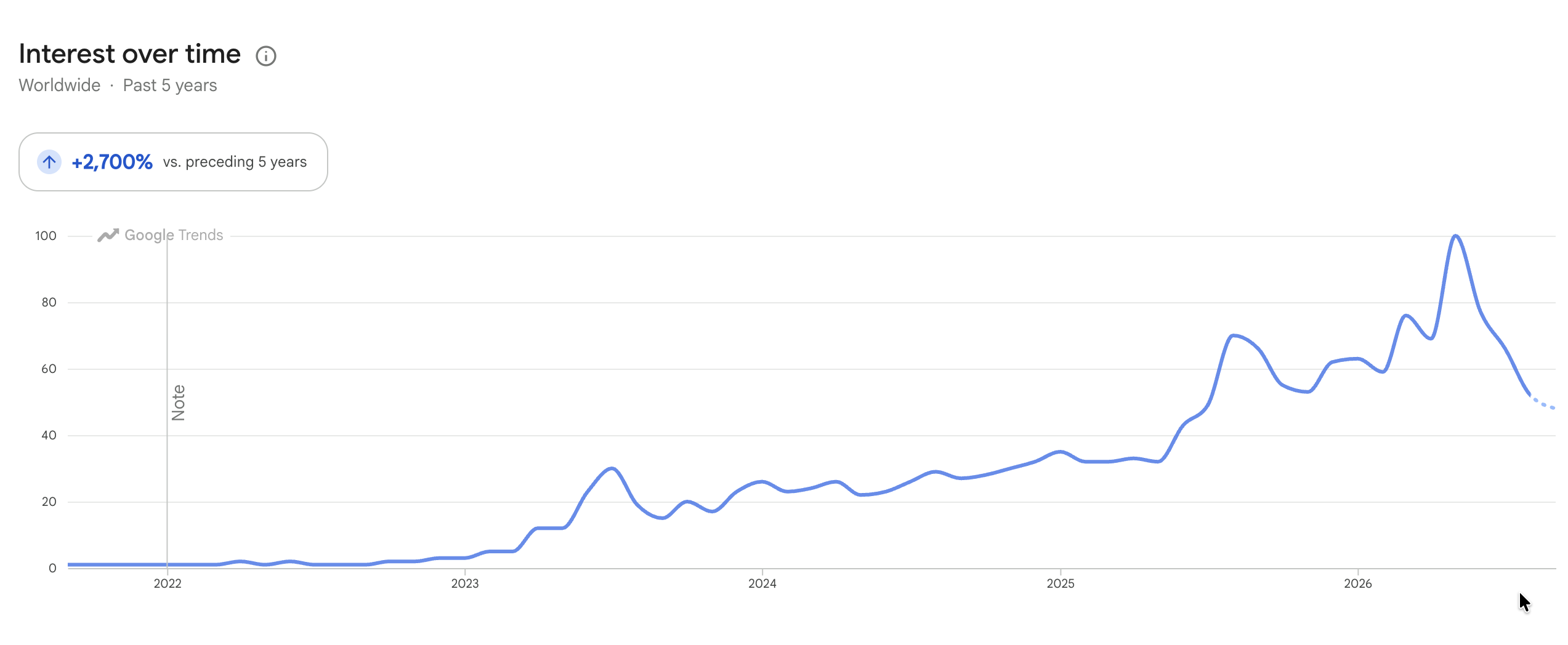
Search interest in “AI girlfriend” was close to nonexistent in 2021 and 2022, then climbed sharply — the annual average search index went from about 1.5 in 2022 to 15.3 in 2023, 26.3 in 2024, and 46.8 in 2025, before hitting its five-year peak in May 2026 [7].
Google Search interest in “AI girlfriend”
That’s a real, multi-year trend, not a one-week spike.
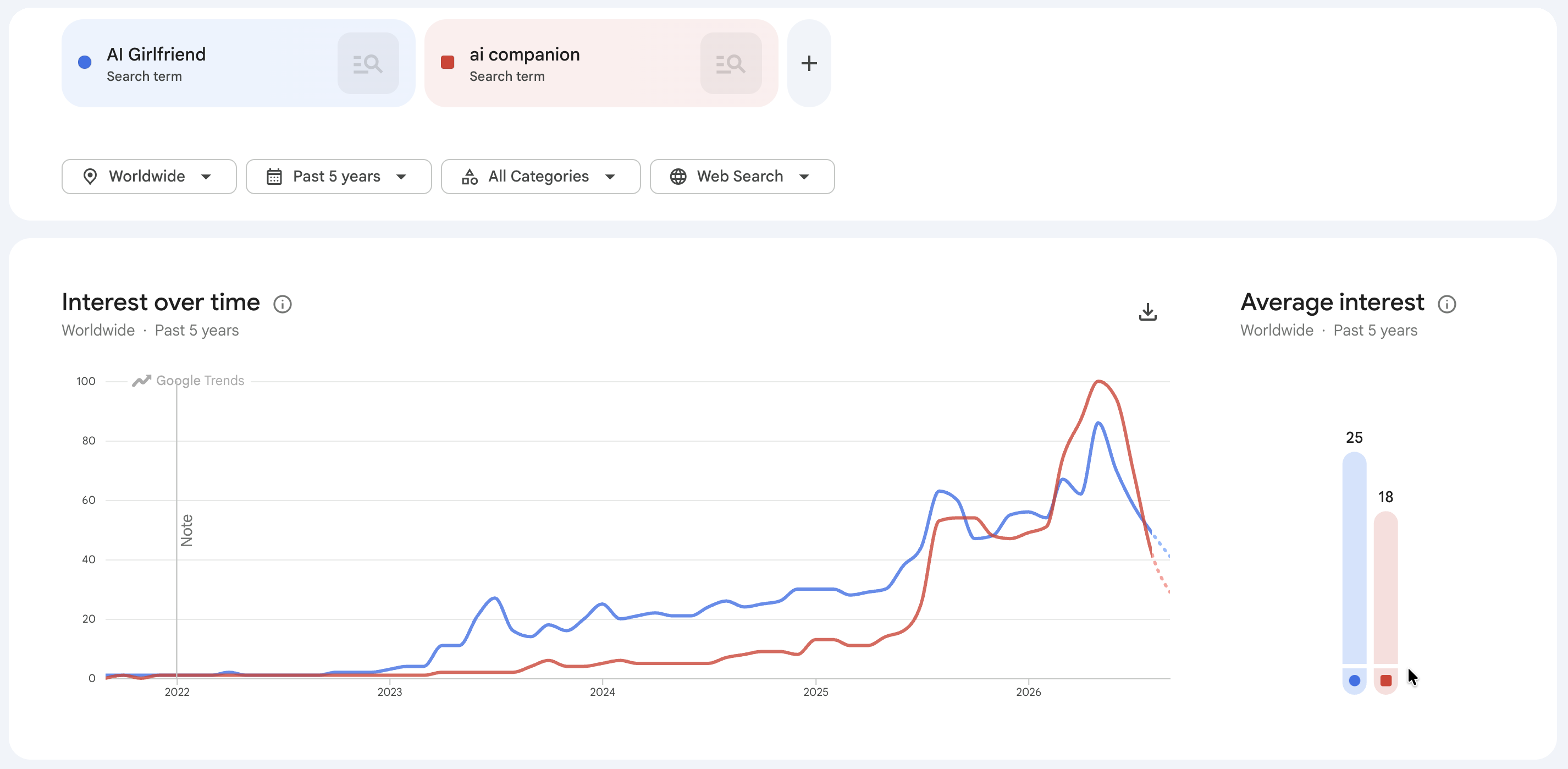
Interestingly, the broader term “AI companion” has been catching up to — and in several recent months, overtaking — “AI girlfriend” specifically [9].
“AI girlfriend” vs “AI companion” worldwide Google search interest
Its rise suggests that public interest — or at least the language people use when searching — is broadening beyond the explicitly romantic “AI girlfriend” framing.
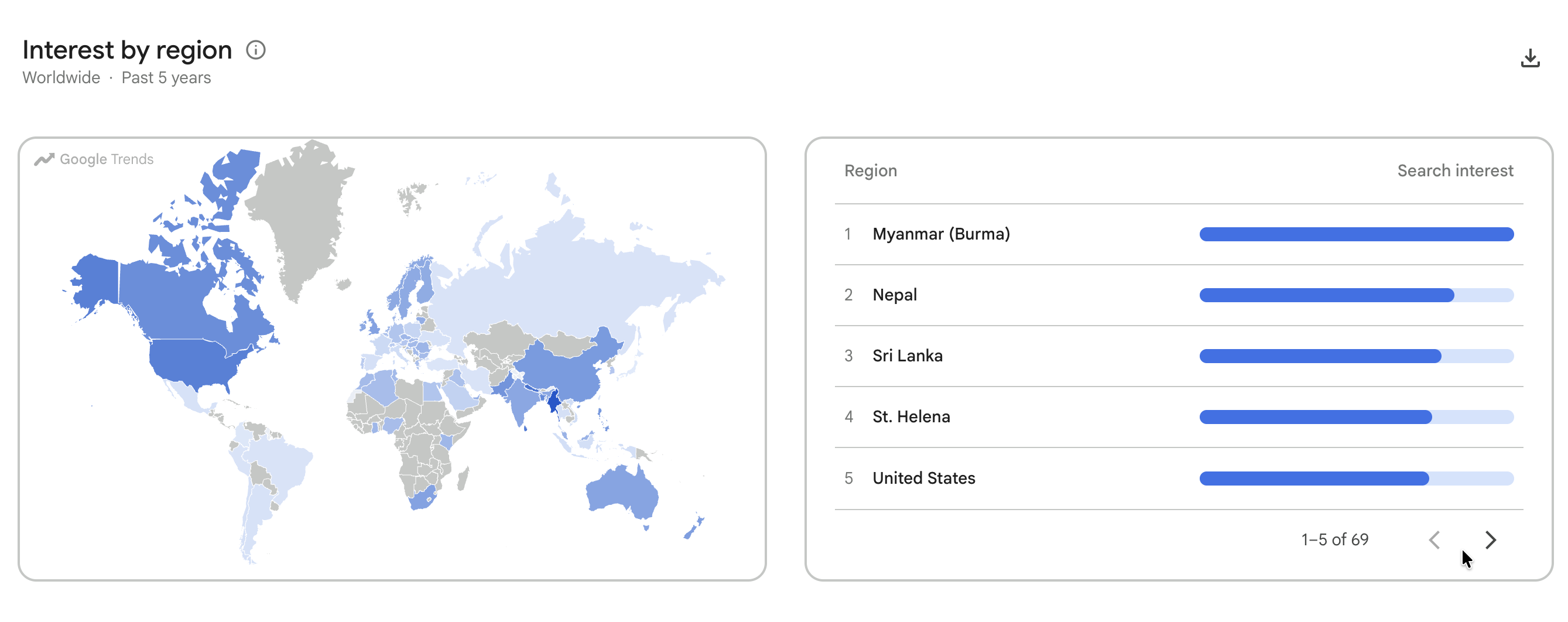
Geographically, search interest is highest (relative to each country’s own search volume) in Myanmar, Nepal, and Sri Lanka, with the U.S. ranking fifth [8].
Countries and regions with the highest relative interest in “AI girlfriend”
Worth noting: that ranking measures the share of a country’s total searches, not the number of actual users — a small country can top the list with a much smaller absolute number of searches than the U.S. generates. It tells you where the topic is unusually prominent, not where the most people are actually using AI companions.
Commercial forecasts project the global AI companion market growing from around $36.8 billion in 2025 to as much as $318 billion by 2033 [6]. Numbers like these deserve real skepticism: market-research firms that sell industry reports have a structural incentive to project large growth, methodologies are rarely disclosed in enough detail to check, and forecasts in emerging tech sectors are notoriously prone to overshooting actual outcomes by wide margins. This figure says something about how the industry is pitching itself to investors — not a reliable measurement of how many people are actually using these products, or how fast that number is really growing.
The Bottom Line
Is AI companionship replacing dating? There’s currently little evidence that AI companionship is replacing dating on anything resembling a mass scale — for men or anyone else. Dating apps still beat AI companions by a wide margin when people are asked what they’d actually prefer [5]. Most users still choose friends and family over AI when they want to talk [1]. And the main draw isn’t romance — it’s low-stakes conversation and a sense of being heard.
What is happening is more interesting than a simple replacement story: AI has quietly become a participant in people’s emotional lives — a place to vent, get advice, or feel less alone — running alongside human relationships rather than instead of them. Whether that stays a supplement or starts crowding out real connection for a meaningful number of people is the actual open question, and right now, the honest answer is that nobody has enough data to say for sure.
References:
- The Rise of AI Companions. Janna Anderson and Lee Rainie (Imagining the Digital Future Center, Elon University). Published: September 2, 2026. Elon.edu.
- AI Companions Reduce Loneliness. Julian De Freitas, Zeliha Oğuz-Uğuralp, Ahmet Kaan Uğuralp, and Stefano Puntoni. Published: 2026. Academic.oup.com.
- How AI and Human Behaviors Shape Psychosocial Effects of Extended Chatbot Use: A Longitudinal Randomized Controlled Study. Cathy Mengying Fang, Auren R. Liu, Valdemar Danry, et al. Published: March 21, 2025. Arxiv.org.
- Talk, Trust, and Trade-Offs: How and Why Teens Use AI Companions. Michael B. Robb and Supreet Mann. Published: July 16, 2025. Commonsensemedia.org.
- AI Girlfriend Coach Publishes U.S. Study on Attitudes Toward AI Romance and Cheating. AI Girlfriend Coach. Published: September 7, 2026. Globenewswire.com.
- AI Companion Market Size, Share & Trends Analysis Report, 2026–2033. Grand View Research. Published: 2026. Grandviewresearch.com.
- Google Trends analysis, worldwide. Search term “AI girlfriend,” September 2021–September 2026, monthly interest-over-time data.
- Google Trends analysis, worldwide. Search term “AI girlfriend,” September 2021–September 2026, interest-by-region data.
- Google Trends analysis, worldwide. Search terms “AI girlfriend” and “AI companion,” September 2021–September 2026, comparative monthly data.
Head Researcher