


Head Researcher
Exploring your sexual identity is a deeply personal journey, and many turn to a free online gay test to find initial clarity. If you have ever found yourself wondering, “Am I gay, straight, or somewhere in between?” you are absolutely not alone. This comprehensive guide breaks down the mechanics of these popular personality quizzes and carefully evaluates overall accuracy and reliability. The guide also explores exactly why people take them, how to interpret the results, and what various sexual orientations actually mean today. Let’s begin.
Table of Contents
What Is a Gay Test?
A gay test is typically an interactive questionnaire designed to help you map your romantic, emotional, and physical attractions. According to a Gallup survey, 7.6% of U.S. adults identify as LGBTQ+, a number that has steadily risen as societal stigma decreases and self-awareness tools become more accessible [1]. The real goal of a modern assessment is not to slap a permanent label on your forehead but to give you a mirror to reflect on your own experiences.
These assessments present a series of targeted questions about your romantic attractions, emotional connections, and physical desires. Based on your answers, the quiz calculates a percentage or provides a descriptive result indicating where you might fall on the spectrum of human sexuality.
It’s crucial to remember that these tools are meant for self-discovery, introspection, and entertainment, not as a substitute for professional psychological or medical evaluation. It serves as a private, low-pressure way to start connecting the dots about who you are drawn to and why, offering a structured path through the natural confusion of self-discovery.
Historically, these began as lighthearted magazine features. And today, many digital platforms still draw on established psychological frameworks, such as the Kinsey Scale developed by The Kinsey Institute, to provide more nuanced feedback. Per research, sexuality is not a strict binary but a fluid spectrum where attraction can vary in intensity and context over time [2].
Why Do People Take Gay Tests?
For some, it is pure curiosity or a desire for a funny, lighthearted way to explore their identity with trusted friends. For others, it is a genuine search for validation during a confusing or isolating period of self-discovery. A young girl questioning her feelings for her best friend or a man trying to understand his attractions might use these tools to find language for their experiences.
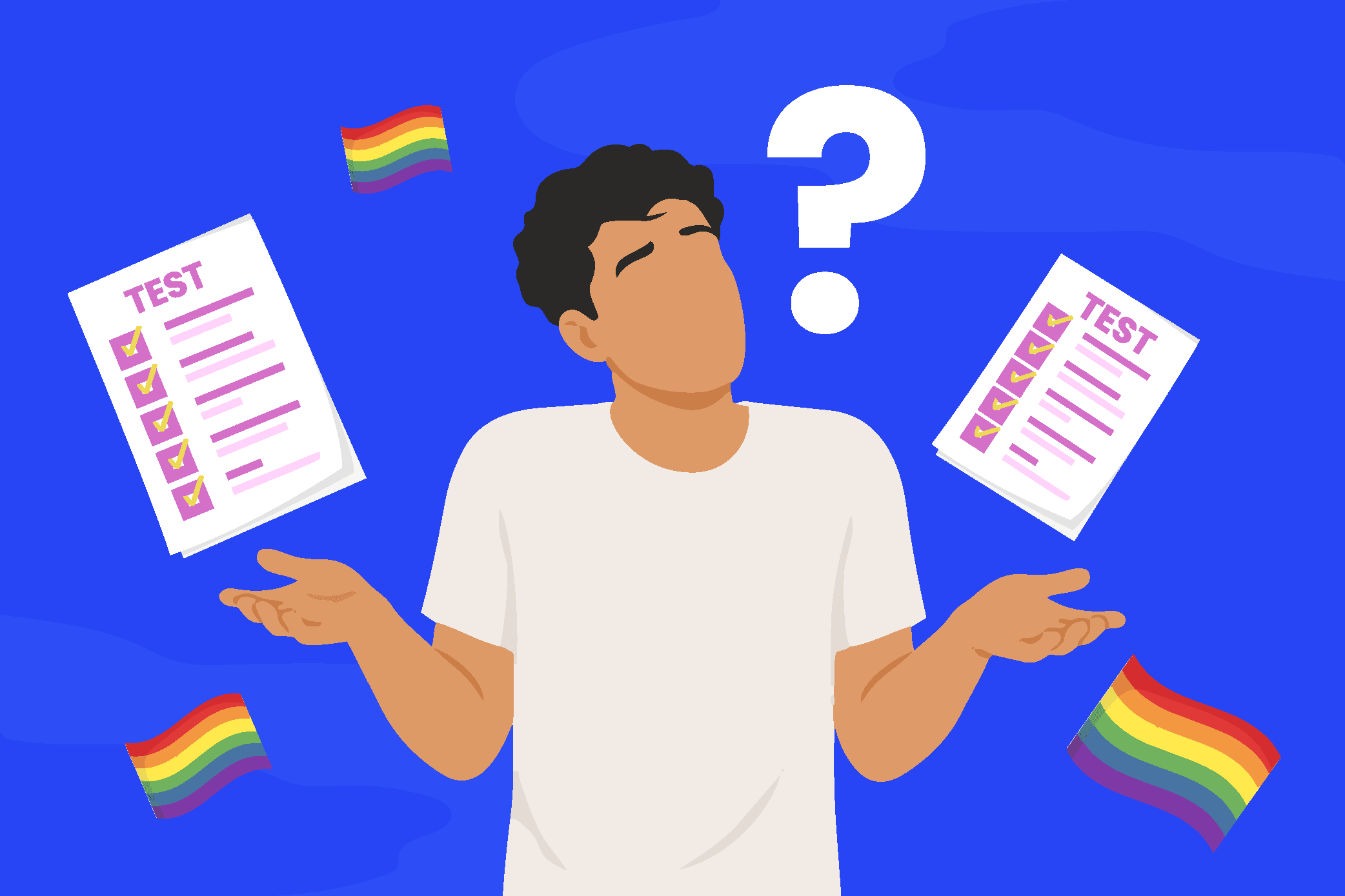
While specific quizzes tailored for men or women exist, the core motivation remains the same: the fundamental human need to understand oneself better. Taking a test can provide a profound sense of relief and community, helping individuals realize that their feelings are normal, shared, and completely valid. It acts as a safe, anonymous scenario where you can explore your personality and desires without fear of judgment.
How Reliable Are Online Tests?
The reliability of an online gay test varies significantly depending on its source, creator, and methodology. While no internet quiz can provide a clinically accurate diagnosis of sexual orientation, some are far better researched than others. A well-designed assessment avoids rigid, outdated stereotypes and instead focuses on emotional and romantic patterns over time. However, many free tests oversimplify complex human sexuality into binary or reductive outcomes.
That said, a thoughtful assessment can still offer real value—helping you identify a pattern that resonates with your lived experience. The most accurate online tools avoid stereotypes and instead ask meaningful questions about who you envision building a life with, who you feel drawn to in a crowd, and how you experience romantic tension over time.
Major genetic studies confirm there is no single “gay gene.” Human sexuality is a complex trait shaped by a mix of biology, environment, and life experiences, making it impossible to predict or categorize through simple metrics [3].
How Does Our Gay Test Work?
Our assessment focuses on emotional, romantic, and physical attraction patterns rather than stereotypes. We focus on who you genuinely feel drawn to—emotionally, physically, and romantically—and analyze your answers to provide a thoughtful, validating result that honors your unique identity.
To ensure accurate reflection, we recommend taking the quiz in a quiet, distraction-free space. Answer every question honestly, trusting your gut reactions rather than societal expectations. You can always retake the assessment as your self-awareness evolves.
To build a comprehensive picture of your desires, the assessment explores real-life dynamics, including the following:
- the importance of emotional connection before physical attraction;
- your genuine reactions to flirting;
- your true preferences regarding casual encounters versus long-term commitment;
- your personal history, including past crushes, dating app comfort, and whether you’ve ever questioned your orientation;
- how quickly you develop attraction;
- your thoughts on “love at first sight”;
- your ideal partner traits;
- vulnerable feelings of being “different” or “out of step,” etc.
By evaluating these dimensions, the assessment provides a more complete picture of your attraction patterns.
About Sexual Orientations From Our Test
When you complete the assessment, the results break down your orientation tendencies into clear, understandable categories based on your overall pattern of attraction. Instead of reducing your complex identity to a single percentage, our results provide a detailed, descriptive breakdown of where your inclinations lie. Here’s what the outcomes mean:
- demisexual: Your results may indicate that you experience sexual attraction only after forming a strong, meaningful emotional bond. For you, romance, trust, and deep connection are the essential gateways to physical desire;
- straight (heterosexual): Your answers might highlight a primary, consistent attraction exclusively to people of the opposite gender, reflecting a traditional alignment of your romantic and physical desires;
- asexual: You could identify with experiencing little or no sexual attraction. Importantly, this does not mean you are incapable of love—deep romantic feelings and a desire for partnership may still be very much present;
- gay (homosexual): Your responses may reveal a clear, consistent attraction to people of the same gender, validating feelings and patterns you may have suspected or quietly observed in yourself for a long time;
- bisexual: The outcome might show an attraction to both men and women (or multiple genders). This result acknowledges that your attraction doesn’t have to be split equally, nor does it have to be experienced in the same way toward different genders.
Whether your results point clearly to one orientation or reveal a nuanced blend of several, the most important takeaway is self-compassion.
Remember that only you can define what feels true to your heart. Let these insights be a stepping stone toward embracing your authentic self with confidence and peace.
Start Test
Ready to explore your attraction patterns? Take the quiz and receive your results in just a few minutes.
Whether you are a young girl questioning your feelings, a man seeking clarity, or anyone navigating attractions to both men and women while quietly wondering, “Am I really this way?”, our free online Gay Test with 30 fun and thoughtful questions is here to help. It may help you reflect on your feelings.
Some Other Ways to Determine Your Sexual Orientation
Here are a few complementary approaches:
- mindful journaling: Writing down your feelings, crushes, and romantic fantasies over several months can reveal undeniable patterns that a quick assessment might miss;
- media awareness: Notice which actors, characters, or storylines consistently evoke a visceral emotional or physical response in you;
- understanding physical preferences: Self-discovery also involves exploring various facets of physical attraction. For many, understanding what specifically draws them to certain partners is a key part of mapping their sexual orientation. This can include curiosity about anatomy and its relation to their personal desires. For example, someone might research topics like the average penis size in America to demystify personal insecurities, better understand their own physical preferences, or clarify what they find appealing in a romantic or sexual context;
- relationship reflection: Sometimes, a “best friendship” that felt unusually intense, protective, or emotionally charged was actually an early, unspoken romantic attachment;
- exploring inclusive spaces: Seeking out welcoming, real-world environments can provide profound clarity. For some, visiting a body-positive, accepting space like a gay nude beach can offer a sense of freedom and community connection that helps them understand their physical attractions in a natural, unpressured setting;
- separating desire from expectation: Ask yourself honestly, “Do I want this because I am supposed to or because it genuinely brings me joy?”
While these self-guided steps are incredibly powerful, talking to an LGBTQ+-affirming therapist remains the most reliable, professional way to navigate complex feelings and build a strong, authentic sense of self.

Final Thoughts
A well-designed quiz can offer a helpful check on your feelings—but it can never replace the lived experience of your own heart and mind.
Human sexuality is inherently fluid. A test result or a calculated percentage is just a snapshot in time, not a permanent contract. Labels are meant to be useful tools that give you language, clarity, and a sense of community—not rigid cages that confine your evolving self. If you have questions or would like additional support, an LGBTQ+-affirming therapist or counselor can help you explore your feelings in a supportive environment.
References:
- LGBTQ+ Identification in U.S. Now at 7.6%. Published: March 13, 2024. News.gallup.com.
- The Kinsey Scale. Retrieved: July 20, 2026. Kinseyinstitute.org.
- There is no ‘gay gene.’ There is no ‘straight gene.’ Sexuality is just complex, study confirms. By Nsikan Akpan. Published: August 29, 2019. Pbs.org.
Head Researcher