


Head Researcher
Dating apps have introduced a vocabulary that can make relationship preferences easier to communicate, but not every abbreviation is immediately obvious. So, what does ENM mean on dating apps? Understanding ENM helps clarify how people describe their relationship expectations and what they may be looking for in a potential partner. This guide covers common ENM arrangements, how they differ, what to clarify when encountering the term, and how relationship preferences can influence compatibility.

Table of Contents
What Does ENM Mean on Dating Apps?
ENM stands for Ethical Non-Monogamy. Monogamy generally involves an agreement to maintain romantic and/or sexual exclusivity with one partner. In contrast, ethical non-monogamy allows people to have multiple romantic or sexual connections with the informed consent of those involved [1]. The “ethical” aspect means everyone involved knows about and agrees to the arrangement, which sets it apart from cheating or deception.
When someone includes ENM in a dating profile, they typically mean that:
- they are interested in dating or forming relationships without requiring exclusivity;
- they may already have one or more partners, or they may currently be single;
- they value informed consent and agreements that allow everyone involved to understand the relationship structure.
However, ENM does not automatically mean casual dating or an unwillingness to commit. An ENM relationship requires high levels of communication, clear boundaries, and emotional accountability—often meaning the person is committed to specific relationship agreements, just not a traditional monogamous framework.
They can develop meaningful emotional attachments, maintain long-term partnerships, and value commitment. The specific arrangement depends on the people involved and the agreements they make. Dating profiles may also include other abbreviations. For example, GGG meaning on dating apps explains another term that can help users understand dating expectations, although GGG and ENM describe different concepts.
What Does ENM Mean on Tinder, Bumble, and Hinge?

While ENM has the same general meaning across Tinder, Bumble, and Hinge, users may communicate their relationship preferences through bios, profile features, or conversations:
- Tinder: Users may mention ENM directly in their bios or use available relationship-type options to communicate that they are interested in non-monogamous dating;
- Bumble: Frequently included in the text bio or explicitly stated right away in the first message;
- Hinge: Commonly integrated into Hinge’s relationship “Relationship Type” profile badge or addressed directly through creative Prompt answers (e.g., answering “The hallmark of a good relationship is…” with “Radical honesty, clear communication, and practicing ENM”).
Examples of how someone might use it in a dating profile include:
- “In an ENM relationship. My partner and I date separately. Just here looking for good conversations, museum dates, and seeing where things go. Tell me your favorite local coffee spot!”
- “Happily married and practicing ethical non-monogamy (ENM). I’m looking to connect with solo individuals or other ENM folks for meaningful connections and romance. Poly-friendly. Fully transparent, and I expect the same from you!”
- “Live music, weekend hikes, and building honest connections. Still figuring out how to balance my schedule! I’m ENM/solo-poly, so clear communication is my love language.”
Remember that ENM is a starting point, not a complete explanation of someone’s relationship arrangements. A profile may not tell you whether the person has an established partner, what their agreements involve, or what kind of connection they want.
How Does Ethical Non-Monogamy Work?
ENM works through mutual consent, clear agreements, and ongoing communication with freedom to express concerns without pressure. Partners discuss what forms of dating, emotional connection, and commitment they consider acceptable rather than assuming exclusivity. These preferences may differ, making honest conversations essential. Boundaries help clarify expectations around sharing information about other relationships, managing time, introducing partners, and handling changing emotional commitments.
Existing responsibilities, such as long-term partnerships, children, shared finances, and other commitments, also influence how much time and attention someone can offer. Potential partners should understand these circumstances before deciding whether the arrangement suits them. ENM agreements are not fixed rules; participants can revisit and adjust them as their needs or circumstances change.
Types of Ethical Non-Monogamy: ENM vs. Polyamory vs. Open Relationships

While ENM serves as an overarching umbrella, it breaks down into several distinct styles that prioritize different types of connections. Polyamory involves the possibility of maintaining multiple romantic relationships with the knowledge and consent of everyone involved. These connections may vary in emotional intimacy and commitment.
Open relationships often involve an established couple who agree that one or both partners may pursue outside sexual or romantic connections. The specific boundaries and priorities depend on their agreements. For a closer look at participation rates, see our article on how common are open relationships. Swinging generally involves established couples engaging in sexual activities with other couples or singles as a recreational, shared social activity, often taking place at specific parties or events.
Finally, relationship anarchy challenges traditional relationship hierarchies and predefined expectations, allowing people to shape romantic, platonic, and sexual connections through individual agreements. People establish their own commitments instead of automatically prioritizing romantic partnerships over friendships or other connections.
The following table outlines their typical characteristics:
| Relationship style | Primary focus | Key characteristics |
| Polyamory | Multiple romantic relationships | Multiple consensual romantic connections that may vary in emotional intimacy, commitment, and relationship structure. |
| Open Relationship | Outside sexual and/or romantic connections | Often involves an established relationship that allows outside sexual and/or romantic connections, depending on agreed boundaries. |
| Swinging | Shared recreational sex | Couple-centric activity, heavily social, often done together at parties or clubs. |
| Relationship Anarchy | Autonomy and customized bonds | Relationships are shaped by individual agreements rather than predetermined hierarchies or conventional relationship expectations. It treats friendships and romance as equally valuable. |
These types aren’t rigid boxes and overlap in the real world. A couple might start in an open relationship and gradually transition into polyamory as deep feelings develop, or individuals might blend elements of multiple styles to fit their specific needs.
Is ENM the Same as Cheating?
No. ENM differs from cheating because it is based on informed consent, transparency, and mutual respect. In monogamous relationships, infidelity involves breaking an explicit or implied agreement of sexual and romantic exclusivity. In ENM, everyone involved understands and agrees to the arrangement beforehand, so having multiple partners does not automatically constitute unfaithfulness.
However, cheating can still occur in ENM relationships when someone violates established agreements or acts deceptively. Examples include secretly developing a committed romantic relationship when partners have agreed to casual encounters only, hiding another relationship, misrepresenting intentions, or disregarding agreed boundaries. Breaking an agreement to use protection with outside partners also breaches trust.
Ultimately, ENM does not eliminate the possibility of infidelity; it changes the expectations partners establish. Honesty, consent, and respect for shared agreements determine whether actions remain ethical.
How Common Is Ethical Non-Monogamy?
Ethical non-monogamy is more common than its visibility in everyday dating conversations might suggest. Consensual non-monogamy (CNM) research shows that while it remains a minority choice, a significant portion of the general population has explored or is open to these relationship structures.
Sociological and public polling data reveal a distinct difference between active participation and lifetime experience across various countries. Men are also slightly more likely than women to engage in CNM due to the prevalence of CNM among gay men [2][3].
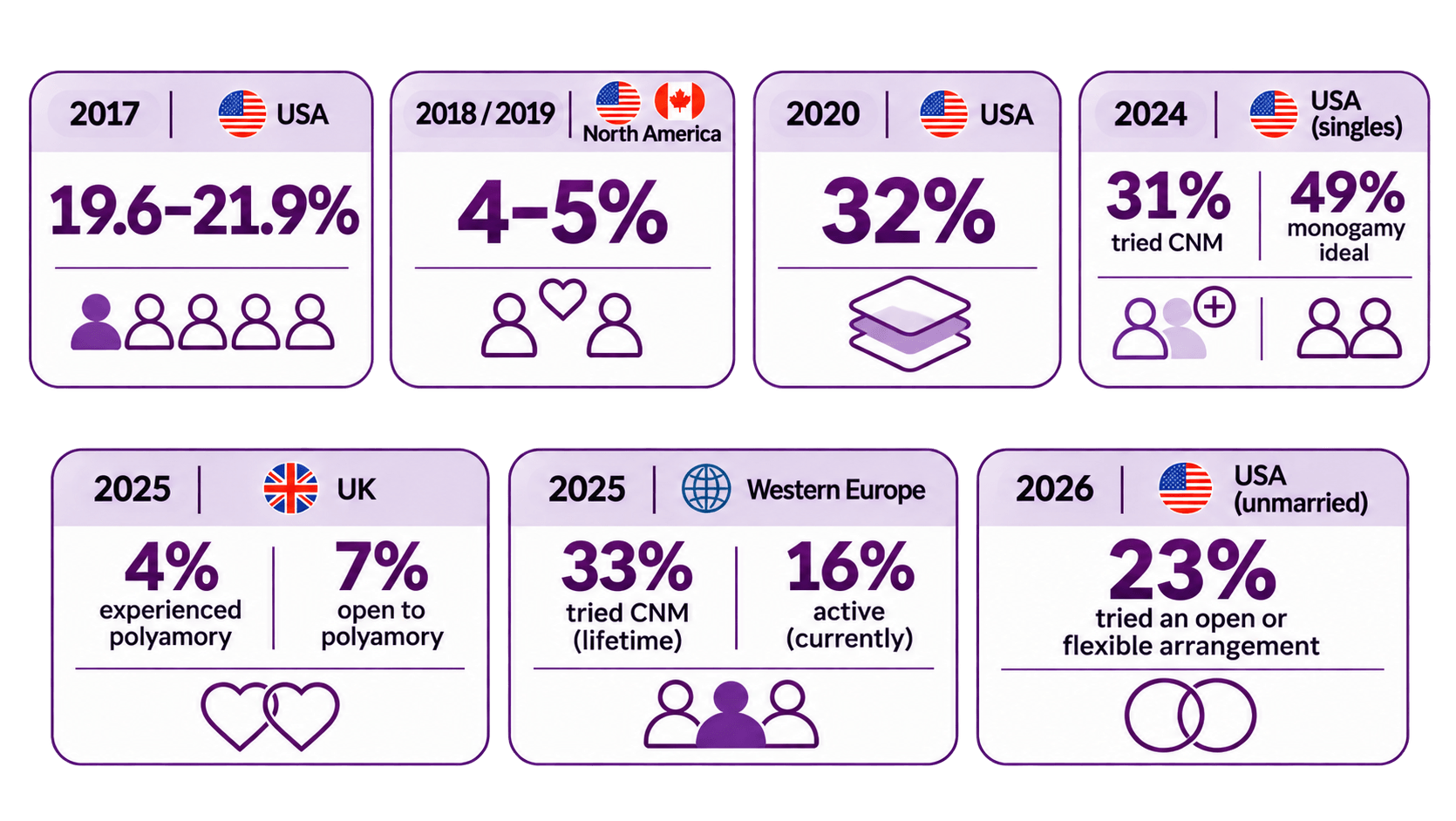
The following are core statistics on consensual non-monogamy:
| Year | Country/Population | Key finding |
| 2017 | USA (Census-based adult samples) | 19.6–21.9% lifetime prevalence: More than 1 in 5 adults have engaged in CNM at some point in their lifetime [3]. |
| 2018 / 2019 | North America (U.S. and Canadian adults) | 4% to 5% of active participants are currently in a relationship and actively practice CNM [2]. This percentage is larger than the entire lesbian, bisexual, and gay population combined. |
| 2020 | USA (General adult population) | 32% public openness: About one-third of U.S. adults state that their ideal relationship structure is non-monogamous to some degree [4]. |
| 2024 | USA (Single adults population) | 31% lifetime exploration among singles: Nearly one-third of single adults have tried CNM, though 49% still view monogamy as ideal [5]. |
| 2025 | UK (General adult population) | 4% specific to polyamory: 1 in 25 Britons have experienced polyamory explicitly, while 1 in 14 (approx. 7%) are open to exploring it [6]. |
| 2025 | Western Europe (Cross-sectional adult tracking) | 33% lifetime vs. 16% active exposure: Comprehensive general population sampling shows 1 in 3 adults have tried CNM in their lifetime, with active participation doubling among male and non-heterosexual demographics [7]. |
| 2026 | USA (Unmarried tracking dataset) | 23% of unmarried adults have tried some form of consensually open arrangement or flexible partnership at least once in their lifetime [8]. |
Another study found that about one-third of Belgian adults had experienced consensual non-monogamy. It’s more common among younger adults and men, while non-heterosexual respondents reported higher involvement [7].
YouGov poll reveals that 34% of Americans prefer a relationship structure other than complete monogamy, with 26% favoring a middle-ground approach rather than total non-monogamy. While adults under 45 are generally more open to flexible relationship styles, preferences differ by gender. Also, 46% of women under 45 prefer complete monogamy compared to 35% of men, who are more likely (46%) to lean toward an in-between arrangement [9].
Interest in non-monogamy should not be confused with sexual fantasies. For example, research into the most common sex fantasy explores desires and imagined scenarios, which do not necessarily reflect the relationship arrangements people choose in real life. When discussing how common ENM is, it’s important to distinguish lifetime experience, current participation, personal interest, and public approval.
How to Date Someone Who Identifies as ENM
Seeing ENM on a dating profile doesn’t tell you everything about a person’s relationship expectations. ENM describes a relationship arrangement, not a particular sexual preference or activity. Interests such as sex role play ideas are separate from whether someone practices monogamy or consensual non-monogamy. Before deciding you are compatible, you must discover what the label means to them and how their existing commitments affect the relationship they can offer:
- understand their relationship status: Determine whether they’re currently dating independently or if they are already in an established, committed partnership;
- verify consent and clarity: If they have existing partners, ask whether those partners are aware of the arrangement and what agreements could affect a new relationship;
- clarify your own expectations: Decide if you want emotional commitment or a less involved connection, as neither should be assumed just because someone identifies as ENM;
- assess communication openness: Look for a willingness to openly discuss expectations, availability, privacy, and boundaries so both understand the arrangement;
- reject vague explanations: Avoid accepting ambiguous answers when important relationship details or structures remain unclear;
- evaluate time and logistics: Ask upfront: “How much time do you realistically have?” and “What is off the table?” Know their limits regarding overnights or meeting family early;
- recognize personal limits: Never compromise your values or accept an arrangement that makes you uncomfortable just to maintain a connection.
Dating someone who practices ENM works best when both people understand each other’s expectations and feel comfortable with the relationship arrangement.
Questions to Ask Someone Who Is ENM
Asking intentional questions early helps you understand their relationship dynamic, set healthy boundaries, and ensure your expectations and emotional capacities are compatible. These questions help clarify important details:
- What does your current relationship structure look like, and how many active partners do you have right now?
- What are your hard boundaries, agreements, or restrictions with your existing partners that could impact our connection?
- How much time and emotional availability do you realistically offer a new partner each week or month?
- Are you looking for a specific type of connection with me, such as casual dating, a long-term romance, or something in between?
- How do you handle partner introductions or public visibility—are your relationships open to friends and family?
- What is your approach to sexual health, including your current testing frequency and preferences for barrier protection with different partners?
The answers give you a clearer understanding of the person’s circumstances without requiring you to make assumptions about their relationship.
What If You Prefer Monogamy?
If you prefer an exclusive relationship, communicate that clearly when discussing dating expectations. You don’t need to agree to ENM if it doesn’t align with what you want, and the other person shouldn’t feel pressured to change their relationship preferences either.
Neither monogamy nor ENM is inherently better. If your expectations are incompatible, it’s reasonable to acknowledge the difference and look for a partner who wants a similar relationship structure.
In Summary
On dating apps, ENM indicates a relationship preference that intentionally differs from conventional exclusivity, encompassing varied arrangements from polyamory to open relationships. If you’re considering dating someone who identifies as ENM, clarify their existing commitments, relationship expectations, and boundaries to determine whether you’re compatible. Finally, neither monogamy nor ENM is inherently superior, making honest, upfront communication essential to determine relationship compatibility.
References:
- What Is an Ethically Non-Monogamous (ENM) Relationship? By Tess Catlett. Medically reviewed by Janet Brito. Published: February 19, 2025. Healthline.com.
- Updated Estimate of Number of Non-Monogamous People in U.S. By Elisabeth A. Sheff. Reviewed by Lybi Ma. Retrieved: November 18, 2026. Psychologytoday.com.
- Desire, Familiarity, and Engagement in Polyamory: Results From a National Sample of Single Adults in the United States. By Amy C. Moors, Amanda N. Gesselman, Justin R. Garcia. Published: March 2021. Pmc.ncbi.nlm.nih.gov.
- One-third of Americans say their ideal relationship is non-monogamous. By Jamie Ballard. Published: January 31, 2020. Yougov.com.
- How American Singles Really Feel About Consensual Non-Monogamy. By Cady Lang. Published: January 24, 2024. Time.com.
- Non-monogamous as happy in their love lives as traditional couples – study. By Nicola Davis. Published: March 26, 2025. Theguardian.com.
- Margins or mainstream: a cross-sectional study on consensual and non-consensual non-monogamy in the general Belgian adult population. By M. Van Den Noortgate, V. Coppens, E. Wuyts, et al. Published: November 10, 2025. Nature.com.
- 2026 Open Marriage Statistics: Understanding the Dynamics and Realities. By Editorial Team. Retrieved: November 18, 2026. Doulike.com.
- How many Americans prefer non-monogamy in relationships? By Linley Sanders. Published: February 21, 2023. Yougov.com.
Head Researcher