


Head Researcher
Curious about how your lifetime number of sexual partners compares with population statistics? Many adults consider this question when thinking about relationships, intimacy, and social expectations. However, the average number of sexual partners is not a single universal figure. It varies by age, gender, country, survey methods, and definitions investigators use when collecting data.

This guide examines research on lifetime sexual partners, particularly the available statistics for men and women in the US. It also compares findings from the UK and France and considers whether a high or low partner count impacts relationship compatibility or personal well-being.
Table of Contents
What Is the Average Number of Sexual Partners?
According to the US Centers for Disease Control and Prevention (CDC), the median lifetime number of opposite-sex sexual partners among sexually experienced adults aged 25–49 was 4.3 for women and 6.3 for men in the 2015–2019 National Survey of Family Growth (NSFG). These figures come from a special tabulation by the National Center for Health Statistics (NCHS) and include partners with whom respondents had vaginal, oral, or anal sex [1].
These numbers provide a useful national reference point, but they need to be interpreted within the survey’s scope. The figures concern opposite-sex partners and adults aged 25–49 who had previously reported sexual experience with an opposite-sex partner. These figures should therefore not be treated as representative of all adults or all types of sexual relationships.
Survey results also depend on respondents accurately remembering and disclosing their experiences. Lifetime partner counts are self-reported, meaning recall difficulties, differences in how people understand survey questions, and willingness to disclose personal information can affect the findings. These limitations matter when comparing results from different countries or research projects.
Another important consideration is the difference between the mean and median. Although both describe a dataset’s central point, they are calculated differently. The median is the middle value when responses are arranged from lowest to highest. At least half of respondents reported a count at or below the median, while at least half have a count at or above it.
The mean, commonly called the arithmetic average, is calculated by adding all reported partner counts and dividing the total by the number of respondents. Unlike the median, the mean can be substantially influenced by a relatively small number of unusually high responses. For example, a few very large values can raise the overall mean even when most respondents report considerably lower numbers.
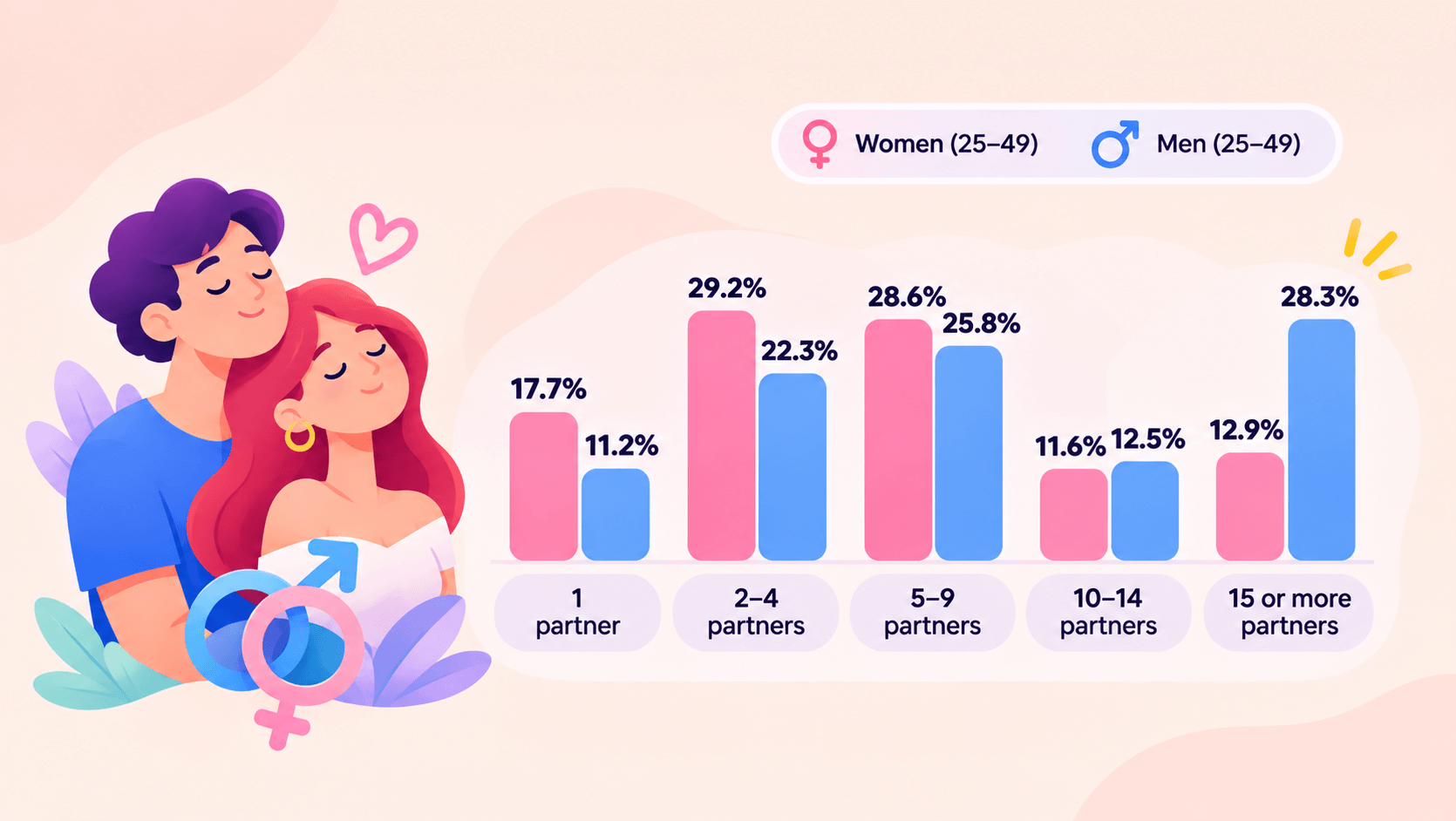
Beyond the median, the CDC also reports how lifetime opposite-sex partner counts are distributed among sexually experienced adults aged 25–49. The following figures show the percentage of men and women in each category [1].
| Number of lifetime opposite-sex partners | Women aged 25–49 (%) | Men aged 25–49 (%) |
| 1 partner | 17.7% | 11.2% |
| 2–4 partners | 29.2% | 22.3% |
| 5–9 partners | 28.6% | 25.8% |
| 10–14 partners | 11.6% | 12.5% |
| 15 or more partners | 12.9% | 28.3% |
The distribution highlights substantial variation within each group. In particular, men were more likely than women to report 15 or more lifetime opposite-sex partners, while the largest percentage of women reported between two and four partners.
These findings show that lifetime partner counts vary considerably within each population. The median provides a useful summary, while the distribution helps explain how individual responses are spread across different ranges.
Average Number of Sexual Partners by Age and Gender
Lifetime partner counts can differ by age group because people have different amounts of time in which to accumulate relationship experiences. However, age does not produce a uniform increase across all populations. Differences between generations, relationship patterns, and individual circumstances also influence the results.
Gender comparisons require similar care. Some surveys find that men report higher lifetime opposite-sex partner counts than women; however, it is not accurate to assume that the difference is explained entirely by men exaggerating or women underreporting. Several factors can contribute to the gap [2].
Differences between men’s and women’s reported partner counts may reflect survey methods, sample composition, recall, and reporting patterns. Broader changes in dating behavior may also provide useful context. For example, approximately 56% of Gen Z adults reported having been in a romantic relationship during their teenage years, compared with around 75%–78% of older generations. However, these figures describe teenage relationship experience rather than lifetime sexual partner counts [3].
That said, lifetime partner counts generally increase across older age groups because people have had more time to form relationships and accumulate experiences. However, the pattern is not necessarily a steady increase at every age.
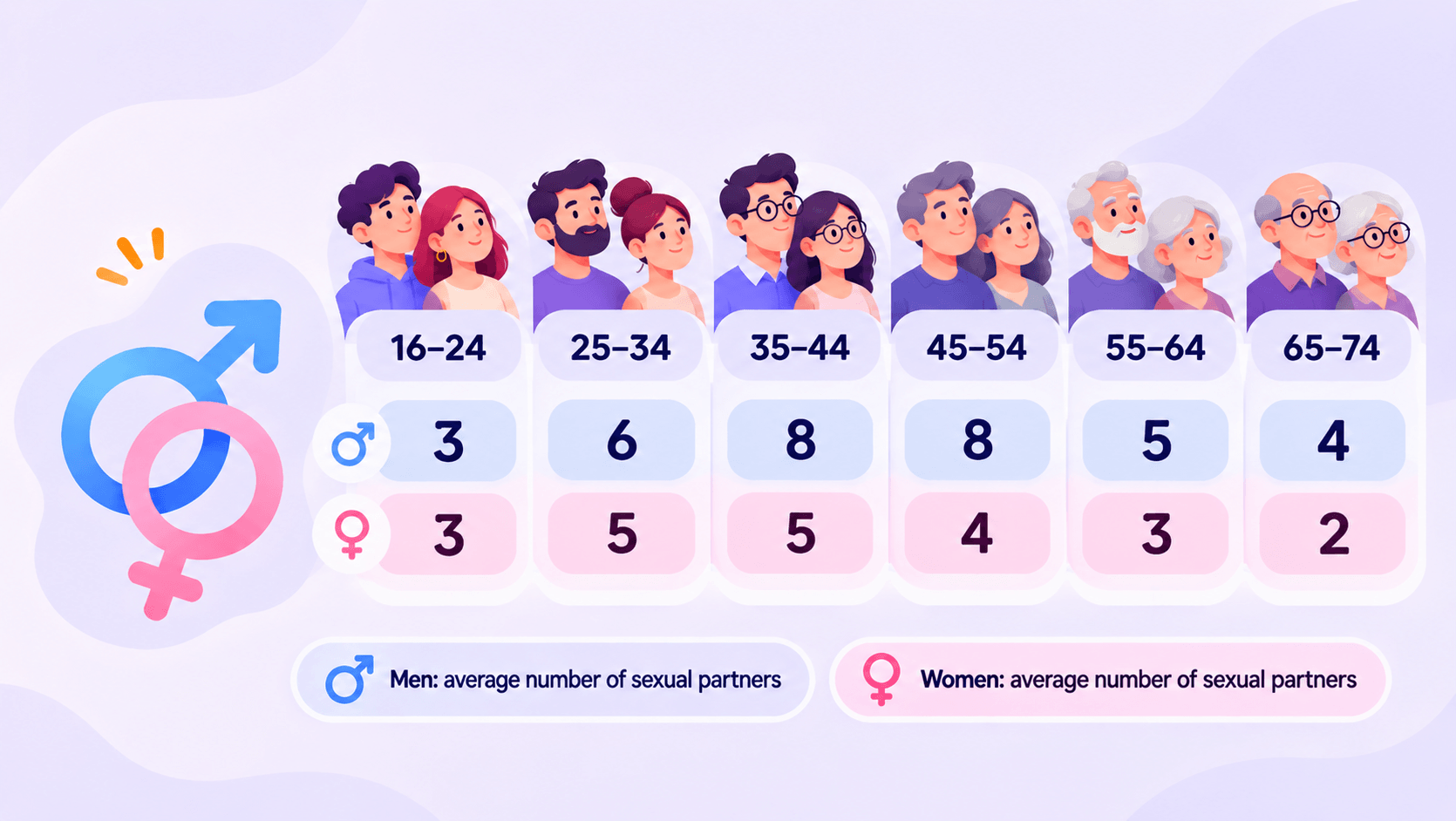
The UK’s third National Survey of Sexual Attitudes and Lifestyles (Natsal-3), conducted in 2010–2012, provides a useful comparison. The table below shows the median (not mean) number of lifetime opposite-sex partners among men and women aged 16–74 [4].
| Age group | Men | Women |
| 16–24 | 3 | 3 |
| 25–34 | 6 | 5 |
| 35–44 | 8 | 5 |
| 45–54 | 8 | 4 |
| 55–64 | 5 | 3 |
| 65–74 | 4 | 2 |
The figures show differences between age groups and genders, but they should not be interpreted as targets or expectations. The older groups also reflect different generations, whose social circumstances and relationship experiences may differ from those of younger adults.
Importantly, the above are UK findings, not US age-specific estimates. When analyzing American data, public health researchers rely primarily on the median rather than the mean. The median is often more informative for skewed distributions because it is less affected by unusually high values than the mean.
Average Number of Sexual Partners by Country
International comparisons provide another perspective on lifetime partner counts, but they require careful interpretation. Countries do not always use the same survey questions, age ranges, definitions, or data-collection periods. Some research reports means, while other studies report medians, making direct rankings difficult to interpret.
For example, the United States CDC figures discussed earlier represent median lifetime opposite-sex partners among sexually experienced adults aged 25–49. France’s national Context of Sexuality in France (CSF) survey, by comparison, reports mean lifetime partner counts among adults aged 18–69 who have previously had sexual intercourse. These are different statistical measures and populations, so their results should not be treated as directly interchangeable [5].
The French CSF-2023 survey recorded a mean of 7.9 lifetime partners among women and 16.4 among men aged 18–69. The research also compared these findings with earlier French surveys in 1992 and 2006, providing a useful example of how national studies can track changes over time [5].
Such findings demonstrate why the year and methodology behind a statistic matter. A figure collected from adults in one country cannot automatically predict the experiences of people in another. Differences may reflect the population sampled, the questions asked, the age distribution of respondents, and the way researchers calculate the results.
Country rankings published by World Population Review can be interesting starting points, but should not be treated as definitive scientific comparisons unless their underlying surveys and methods are clearly documented. A ranking that combines estimates from different sources may place countries side by side without establishing that the figures were collected under comparable conditions.
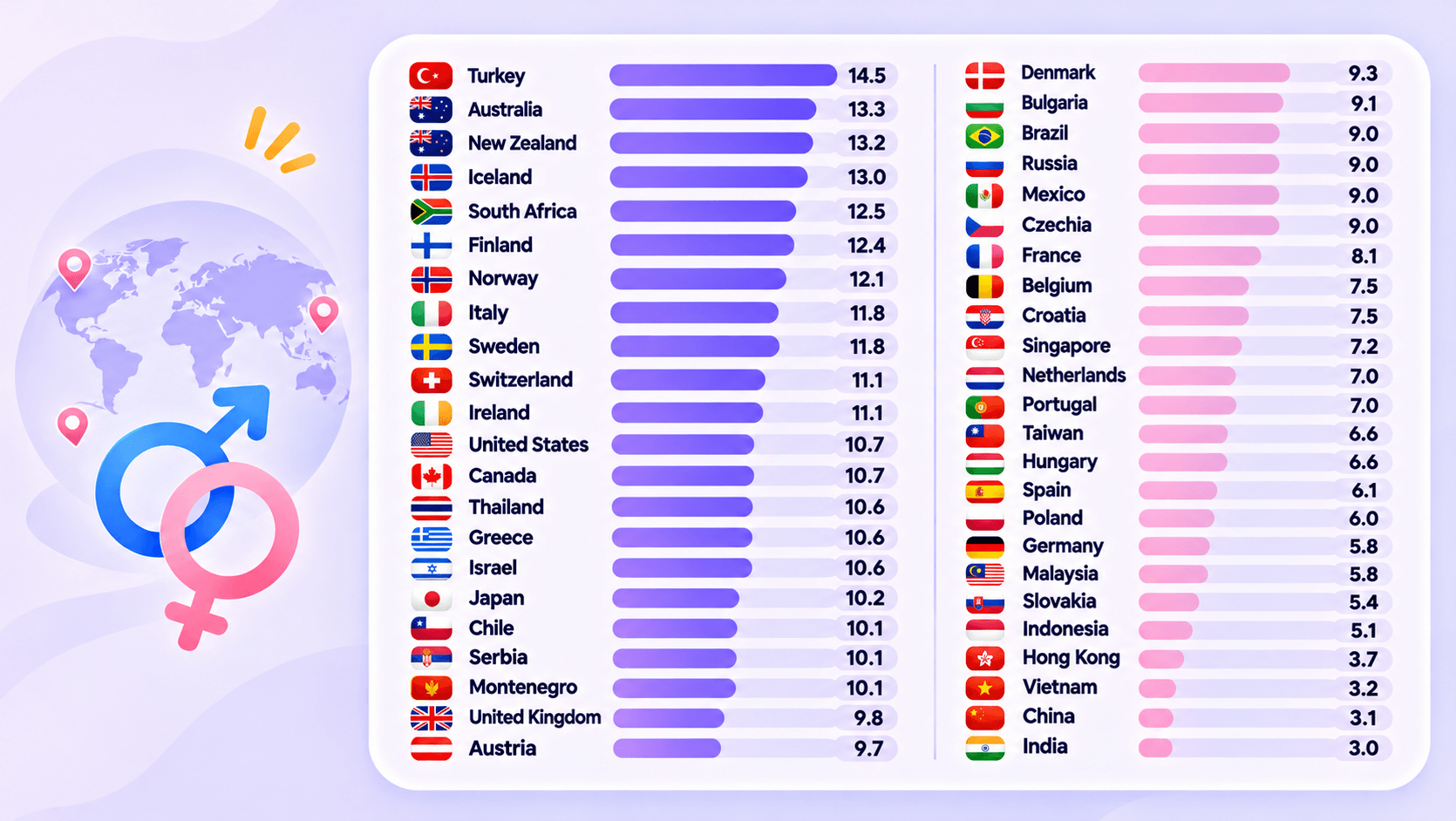
The following table presents published estimates of lifetime sexual partners across 46 countries, as compiled by World Population Review. These figures are provided for general reference rather than as a scientifically standardized global ranking, since the underlying survey years, populations, and methodologies are not consistently documented [6]:
| Country | Average lifetime partners |
| Turkey | 14.5 |
| Australia | 13.3 |
| New Zealand | 13.2 |
| Iceland | 13.0 |
| South Africa | 12.5 |
| Finland | 12.4 |
| Norway | 12.1 |
| Italy | 11.8 |
| Sweden | 11.8 |
| Switzerland | 11.1 |
| Ireland | 11.1 |
| United States | 10.7 |
| Canada | 10.7 |
| Thailand | 10.6 |
| Greece | 10.6 |
| Israel | 10.6 |
| Japan | 10.2 |
| Chile | 10.1 |
| Serbia | 10.1 |
| Montenegro | 10.1 |
| United Kingdom | 9.8 |
| Austria | 9.7 |
| Denmark | 9.3 |
| Bulgaria | 9.1 |
| Brazil | 9.0 |
| Russia | 9.0 |
| Mexico | 9.0 |
| Czechia | 9.0 |
| France | 8.1 |
| Belgium | 7.5 |
| Croatia | 7.5 |
| Singapore | 7.2 |
| Netherlands | 7.0 |
| Portugal | 7.0 |
| Taiwan | 6.6 |
| Hungary | 6.6 |
| Spain | 6.1 |
| Poland | 6.0 |
| Germany | 5.8 |
| Malaysia | 5.8 |
| Slovakia | 5.4 |
| Indonesia | 5.1 |
| Hong Kong | 3.7 |
| Vietnam | 3.2 |
| China | 3.1 |
| India | 3.0 |
These figures offer a broad international comparison, but they should be interpreted cautiously. Differences in sample sizes, age ranges, survey dates, definitions of sexual partners, cultural norms, and self-reporting practices can have a significant impact on the number of individuals someone has sex with.
Some countries have substantially lower published estimates than others. For example, World Population Review lists approximately 3.0 lifetime sexual partners for India, compared with 14.5 for Turkey. Cultural expectations, marriage patterns, survey methods, and reporting practices may contribute to such differences, but these figures alone cannot establish why the estimates vary.
Some published estimates also suggest differences in lifetime partner counts across U.S. states. For example, Louisiana has been reported at 15.7 partners and Utah at 2.6. However, these figures should be interpreted separately from the CDC’s nationally representative statistics, and differences between states should not automatically be attributed to religion or local culture without supporting evidence.
Cultural expectations, relationship traditions, and social attitudes may also influence how people approach relationships and answer sensitive survey questions. However, these factors should not be presented as proven explanations for a country’s reported average without research that directly examines the relationship.
For that reason, there is no single international figure that accurately describes the average lifetime number of sexual partners for everyone. National surveys provide useful insights into the populations they study, but their results need to be understood within their specific research settings.
How Has the Average Number of Sexual Partners Changed Over Time?
Lifetime partner counts can change across generations, but identifying long-term trends requires researchers to compare equivalent measures. A study examining premarital sexual experiences, for example, cannot automatically establish how the total lifetime number of partners has changed.
Historical changes in sexual behavior are not always reflected in the same way across different measures. Surveys of premarital sexual experience can help explain broader social changes, but they should not be treated as direct evidence of increases or decreases in total lifetime partner counts [7].
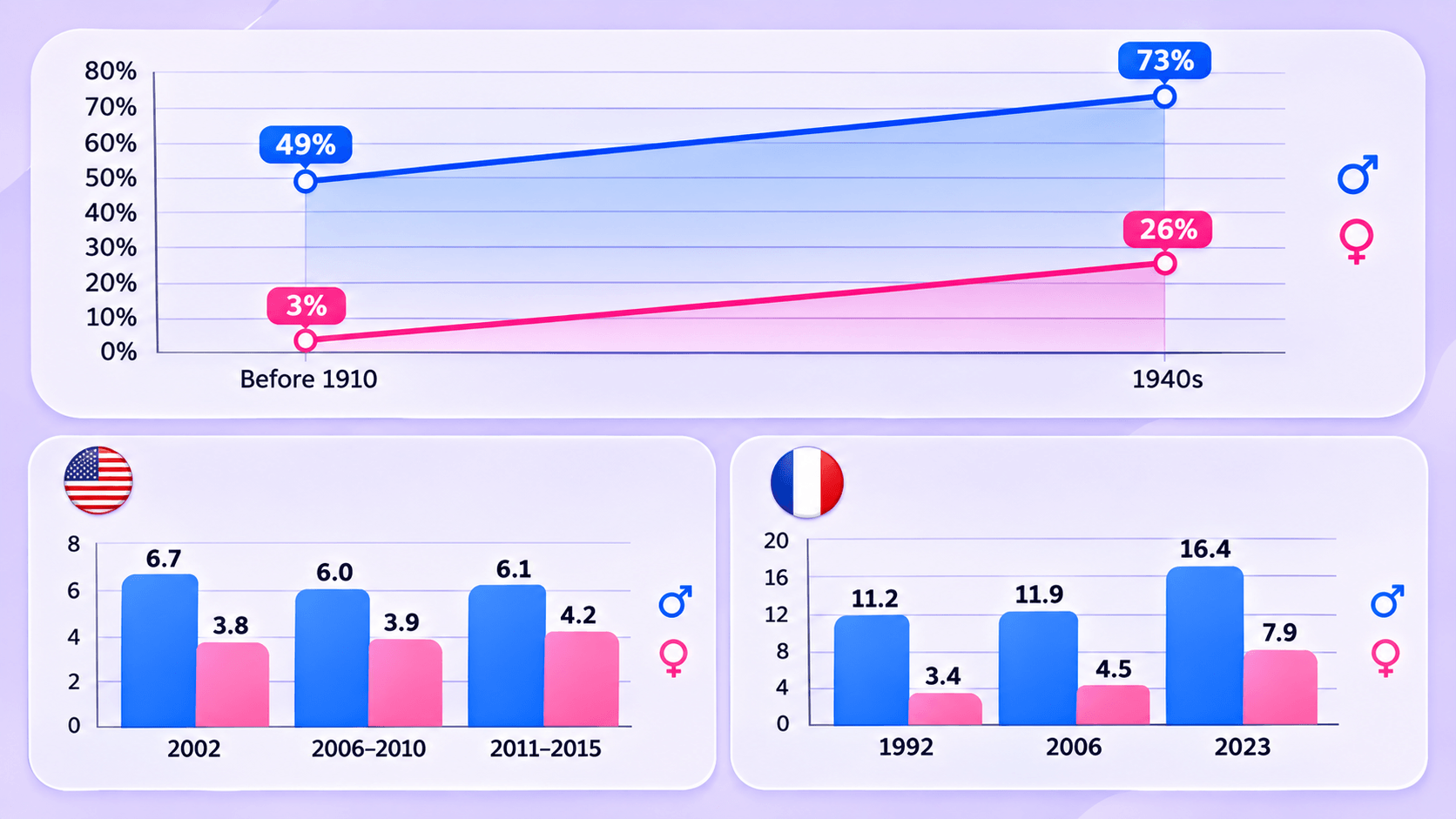
Historical General Social Survey (GSS) data provide additional context about changes in premarital sexual experience across birth cohorts. These findings should be considered separately from studies measuring lifetime partner counts [8]:
- among men born before 1910, 49% reported having two or more premarital sexual partners, compared with 73% of men born in the 1940s;
- among women, the corresponding percentage increased from 3% to 26% across these birth cohorts;
- the median number of lifetime opposite-sex partners started at just 1 for individuals born in the 1910s and 1920s, peaked at 4 for those born in the 1950s and 1960s, and then began a historical contraction.
Historical US data does not show a dramatic increase in the median lifetime number of sexual partners. According to the CDC’s National Survey of Family Growth, the median number of opposite-sex partners among sexually experienced adults aged 25–44 was relatively stable between 2002 and 2011–2015. For men, it changed from 6.7 in 2002 to 6.0 in 2006–2010 and 6.1 in 2011–2015. For women, it increased from 3.8 to 3.9 and then 4.2 across the same periods [1].
French national surveys show a different pattern. Among adults aged 18–69 who had experienced sex, the mean lifetime partner count for women rose from 3.4 in 1992 to 4.5 in 2006 and 7.9 in 2023. For men, the mean increased from 11.2 in 1992 to 11.9 in 2006 and 16.4 in 2023. These are means, not medians, and should be interpreted separately from the US figures [5].
What Is Considered a High or Low Body Count?
The informal phrase “body count” refers to the total number of sexual partners an individual has had during their lifetime. What qualifies as a “high” or “low” number varies considerably because people hold diverse personal values, cultural backgrounds, and religious beliefs. Because of these personal and cultural differences, there is no universally accepted number that defines a normal or excessive lifetime partner count.
Perceptions of these figures often differ by demographic and gender. Traditional social stigmas can create a double standard, where some men and women are judged differently. People also place different levels of importance on a potential partner’s sexual history. For some individuals, a partner’s history is a key factor when evaluating relationship compatibility. Others place far greater importance on present qualities like shared values, honesty, trust, and mutual commitment.
Neither perspective is a universal standard. Partners need to communicate openly and respect each other’s expectations without judgment or pressure. Sexual compatibility involves more than past partner counts. It also includes communication about preferences, comfort, and expectations, including questions such as how long should sex last.
Crucially, physical well-being should always be considered separately from a lifetime metric. Having more or fewer partners does not automatically indicate someone’s health status. From a medical standpoint, active behaviors such as consistent barrier protection, regular STI testing, and honest communication about sexual health provide far more meaningful information than a raw lifetime number alone.
Fixating on past metrics can create unnecessary anxiety or performance pressure, distracting from the physical and emotional connection between partners. Discussing sexual preferences and desires, including topics such as the most common sex fantasy, can help partners understand each other’s interests without making assumptions based on their sexual histories.
In Summary
The average number of sexual partners offers useful insight into population-level patterns, but it should never become a standard that people measure themselves or others against. Lifetime partner counts differ across age groups, genders, countries, and generations. However, these figures describe survey populations rather than defining what is normal for an individual. When considering a partner’s sexual history, focus less on the number and more on what matters in a healthy relationship: honesty, mutual respect, trust, compatible expectations, and responsible sexual-health practices.
If sexual health is a concern, open communication and appropriate testing offer more meaningful reassurance than relying on someone’s reported lifetime count. A person’s history does not determine their character, loyalty, or capacity for commitment. What matters most is making informed personal choices, respecting boundaries, and building relationships around shared values rather than social comparisons.
References:
- Key Statistics from the National Survey of Family Growth – N Listing. Retrieved: November 18, 2026. Cdc.gov.
- What’s the Average Person’s Number of Sexual Partners? By Jandra Sutton. Medically reviewed by Janet Brito. Retrieved: November 18, 2026. Healthline.com.
- Gen Z’s Romance Gap: Why Nearly Half of Young Men Aren’t Dating. By Daniel A. Cox. Published: February 9, 2024. Americansurveycenter.org.
- National Survey of Sexual Attitudes and Lifestyles (Natsal-3) (pdf). Retrieved: November 18, 2026. Natsal.ac.uk.
- Age at first sexual intercourse: a comeback in recent years (France hexagonal). Retrieved: November 18, 2026. Csf.inserm.fr.
- Average Number of Sexual Partners by Country 2026. Retrieved: November 18, 2026. worldpopulationreview.com.
- Two New Studies Debunk What You Thought You Knew About Millennials and Sex. By Sandy Hingston. Published: June 1, 2015. Phillymag.com.
- American Sexual Behavior: Trends, Socio-Demographic Differences, and Risk Behavior (pdf). Retrieved: November 19, 2026. Tom W. Smith. Gss.norc.org.
Head Researcher